
Bridging the Digital Desert: Arizona DOT’s Rural Broadband Expansion
February 02, 2026
CHALLENGE:
Ambitious Goals to Modernize Rural Life and Make Travel Safer
“Typically, in most states, the rural areas are the last ones to receive high-speed internet access,” Brad Burgess, Deputy to the State Engineer at Arizona’s Department of Transportation notes. Public servants like Burgess and his colleagues understood that the problems of the digital divide – a significant lag in connectivity among our nation’s rural and underserved communities – was made abundantly clear during the COVID-19 pandemic, and never really got better with the subsidence of the pandemic.
Beyond the inconvenience of slow connections for streaming videos and using social media, the lack of connectivity adds to the challenges that exist for communities that lie far from urban economic hubs. With traditional internet providers often reluctant to invest in costly infrastructure expansions in low-density areas, the Arizona government stepped in to create conditions for more connectivity, more opportunity, and improved quality of life for its residents.
“The state was definitely interested in investing public funds into broadband for a couple reasons: one is the unserved and underserved communities, which means that they don’t have internet today or their internet is very slow, and that kind of got magnified during the time of COVID, when we realized everybody had to start working from home, kids were going to school from home, people were doing telemedicine – so all that only magnified the need to invest in Arizona and get all the communities in Arizona connected,” Burgess explains.
ADOT was also in a position to make traveling throughout the state and to neighboring states easier and safer for drivers. Arizona hosts a variety of national parks, such as the Grand Canyon, and sits between other popular tourism destinations in the Southwest and California. Expanded broadband for agency use would mean better connectivity for electronic messaging signs, traffic cameras, lighting, and other components of a fully modernized Intelligent Transportation System (ITS), and thereby safer traveling conditions.

SOLUTION
Leveraging Public-Private Partnerships
While ADOT’s focus is developing and managing transportation infrastructure throughout the state, its staff understood that like many transportation authorities, they were uniquely well suited to optimize their existing connectivity and communications infrastructure while carrying out already-planned maintenance projects. On top of these advantages, they could also leverage longstanding relationships with other Arizona state government offices as well as private-sector and community partners to develop a plan for a streamlined deployment.
Beginning in 2020, Burgess and others in ADOT coordinated with the Arizona Department of Commerce and the Governor’s office to research and choose sites for their ITS system, and then worked with civil engineering firm Kimley-Horn to design and plan each part of the network. Contractors Sundt and CS Construction managed the construction as well as fiber placement, while EX2 operates and maintains the conduit.
ADOT knew that to make good use of public funds and achieve the goal for this network– bringing much-needed connectivity to rural Arizonans – the infrastructure would need to withstand the harsh desert climate and remain operable for a very long time.
“One of ADOT’s goals is to put in a robust network that will last many years into the future,” Burgess shares.
And with the objectives of the network in mind – inherently multi-use with pathways for ADOT’s ITS and agency communications, commercial use, and leasing, ADOT would need deep experience and innovative thinking for a suitable design. ADOT partnered with experienced civil engineering firm Kimley-Horn, who designed a network using FuturePath Armored 7 Way 18/14 mm to meet these needs while ensuring flexibility and scalability in physical pathways that would stand the test of time and the elements.
Thinking Outside the Box for a Dynamic Project Environment
Because the network spans the entire state of Arizona, ADOT and Kimley-Horn worked with stakeholders across the state to ensure any culturally sensitive sites and protected wildlife remained outside the path of construction. And to keep workers and travelers along Arizona’s roadways safe, Kimley-Horn conducted robust field studies to plan routes away from hazards such as falling-rock zones.
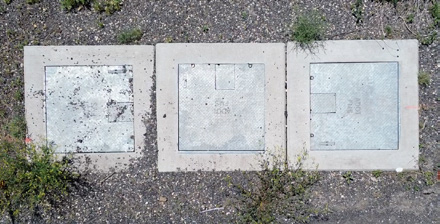
For easy vault access for every party using the network, McCullough also worked with ADOT to design a unique system of three vaults, which creates necessary physical separation between ADOT’s sensitive communication lines, their commercial partner’s fiber, and the leased pathway.
Arizona’s landscape varies wildly not only biologically but also geologically, with areas of deep topsoil, sand, and dense rock. Installers Sundt and CS Construction chose a variety of installation methods and equipment across this 400-mile network to meet the needs of the changing landscape.
“On this project, we have everything from sandy washes to solid, hard rock,” Ross Genenbacher, VP of CS Construction notes. CS, along with Core Media Solutions directional drilling specialists, deployed plows, MicroTrenchers, traditional backhoes, as well as all-terrain directional drills.


RESULTS
Multiple Robust Pathways for Today’s Needs and Future Expansions
With an all-star team of public-private partners, ADOT installed 400 miles of FuturePath Armored 7-way from Dura-Line along highways I-17, I-19, and I-40. All of their infrastructure is buried safely underground, and protected from rodent damage and accidental strikes.
ADOT’s 7 pathways enable a significant boost to their ITS and agency communications, making traveling across the state’s most popular destinations safer and more efficient to manage, all while facilitating a historic expansion in high-speed internet access for rural and underserved residents. And because their fiber is housed inside robust HDPE conduit, it will last far into the future and enable streamlined, low-impact expansions when the need for more fiber inevitably arises.
-

400 miles of conduit
-
405 miles of 288-count fiber
-
3 interstate highways
-
All underground infrastructure
-
7 Pathways